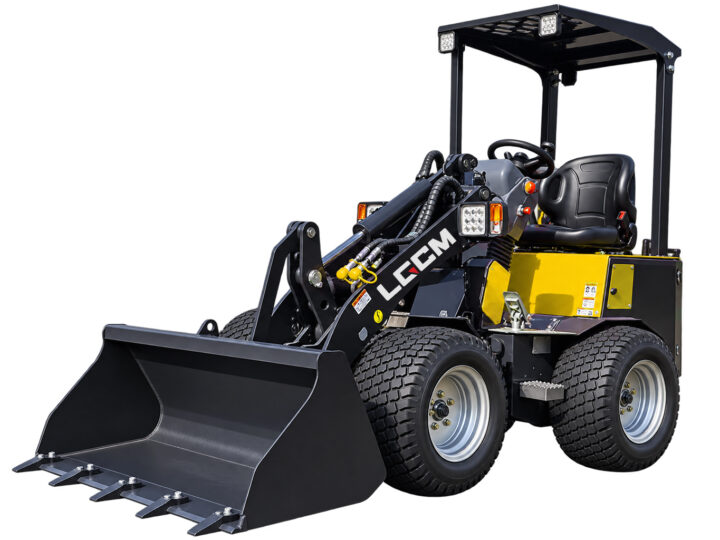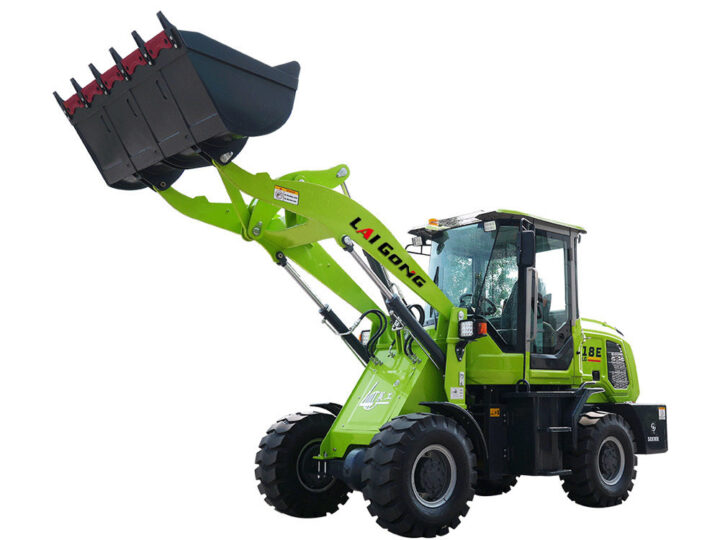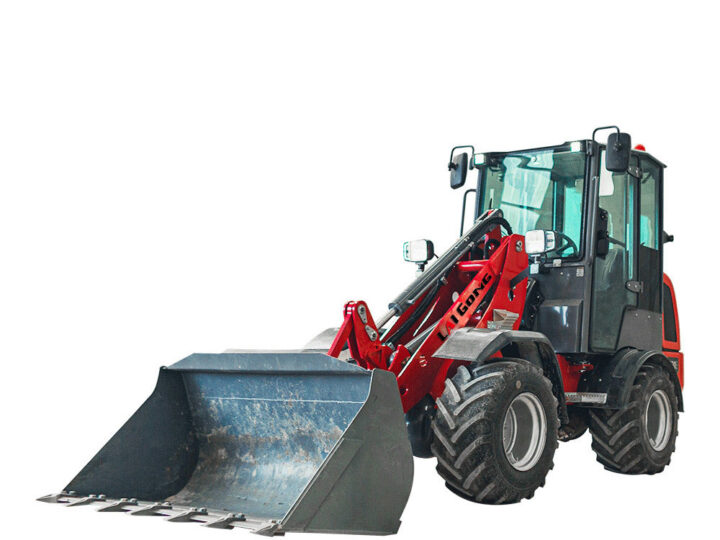
Compact loaders on this site come with three quite different drivetrains. They overlap in size and price, so the useful question is not which is best but which suits the site the machine will spend its life on.
Standard drive
The standard mini wheel loaders use the conventional layout: a diesel engine through a torque converter and a powershift box. It is the simplest of the three, the cheapest to buy and the easiest to repair with general workshop skills. On straightforward loading work — sand, gravel, muck, backfill, load and carry — it is hard to argue with.
Choose it when the machine will be worked hard outdoors, when local service is basic, and when nobody is asking for special emission paperwork.
Hydrostatic drive
The EPA hydrostatic range replaces the torque converter with a hydrostatic transmission, from the H130 up to the H580. Two things change on the controls. Travel speed becomes steplessly variable, so the operator can creep at very low speed with full engine revs available for the hydraulics, and the machine slows and reverses on the drive itself rather than on the brakes.
That matters for precise work: placing a pallet, feeding a crusher, working inside a building, or any job with a lot of shuttling back and forth. It also reduces brake wear on repetitive cycles. The range carries the EPA label because it is built for markets that ask for a certified engine, and as with the Euro 5 loaders you should have us confirm the exact certification for your country in writing.
Electric drive
The electric loaders — the LG18E and the H130E, H220E and H280E — swap the diesel engine for a battery pack and electric motors. The advantages are inherent rather than marginal: no exhaust at the machine, and much less noise.
That opens up sites the diesel machines cannot work on at all. Indoor demolition and material handling, food and agricultural buildings, tunnels, hospital and school grounds, night work in residential streets, and any city job with a noise limit attached to the permit.
The trade-off is planning. An electric machine is only as useful as the charging arrangement behind it, so the questions to settle before ordering are how many hours a shift needs, what supply is available at the site, and how long a charge takes on that supply. Tell us the shift pattern and the available power and we will tell you honestly whether the electric machine fits it.
A rough decision order
- Is there an emission or noise rule on the site or at the border? That decides the range before anything else.
- Is the work precise and repetitive, or bulk loading? Precise and repetitive favours hydrostatic.
- Is the machine indoors or near people? That points at electric.
- Otherwise: the standard range, and put the money into the right attachments.
If you are weighing two of these against each other, tell us the job rather than the model. It is a faster route to the right machine.